Botanical Blog
Winter Weather
posted by GBBG on February 7th, 2012
by Mark Konlock, Director of Horticulture, Green Bay Botanical Garden
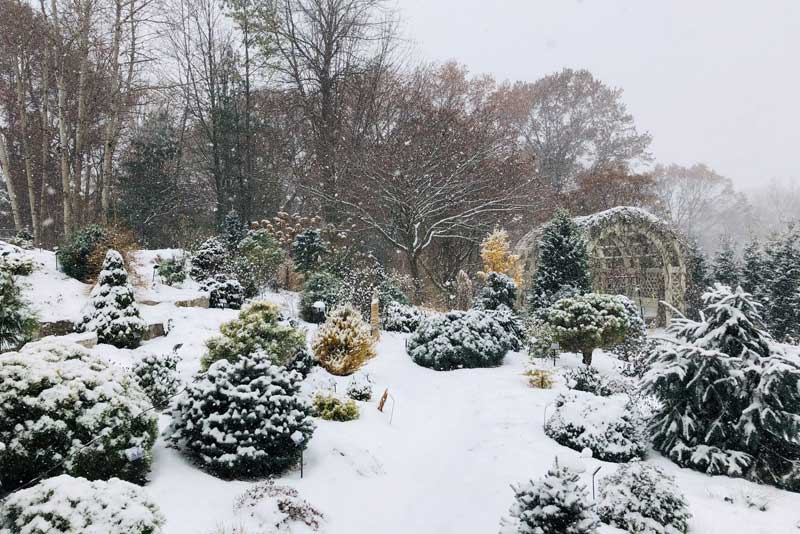
Has this winter made you wonder about the weather? It sure has been mild – well at least until recently. It kind of makes you envious of southern climates - to quote the movie Brokeback Mountain, “It could be like this always.” I recently learned about the Arctic Oscillation from Ashley Wolf, a meteorologist with the National Atmospheric and Oceanic Administration in Green Bay. This is one explanation for our recent mild weather. In essence, what happens is high pressure in the mid latitudes and low pressure in the arctic regions keeps cold air north, giving us a warmer winter. For more a more detailed explanation, click here. Over the last number of years some organizations have been updating maps with the latest climatological data. Check out the 2006 Arbor Day Foundation map where they updated the 1990 USDA hardiness zone map with more recent data. Use the play function to see the changes in average annual minimum temperatures.
At GBBG, we like to push the envelope by trying new plants and have been using zone 5 plants for the last 7 years. Some plants like Eremurus (foxtail lily), Dracunculus (dragon flower), and Acanthus (bear’s breeches) we mulch with about 9 inches of woodchips after the ground freezes to give them a little extra help through their first winter. Plants like Asimina (pawpaw) and other woody ornamentals are sited in areas where they are protected from vicious northwest winter winds as well as make sure they are not in areas where frost pools up in the spring time.
One lesson I learned from our recently retired gardener, Linda Patton, is to take the weather as it comes. When I was getting excited one day a number of years ago, I came back to my desk to see a quote by Lao Tzu written out by Linda on my desk. I have it taped up above my calendar and it reads, “Nature does not hurry, yet everything is accomplished.” Amen to that!
Posted in Uncategorized | No Comments »
Would you like to test out the latest in “green” technology? Visit our new restrooms!
posted by GBBG on November 7th, 2011
by Kelle Hartman, Children & Family Educator, Green Bay Botanical Garden
Who knew what we flushed down our toilets could be so earth friendly! Or, more correctly, what we don’t flush, specifically water. Low flow toilets have been around since about 1994 when the National Energy Policy Act became law. This law required that all toilets sold in the United States use no more than 1.6 gallons per flush. This was a huge improvement from the 5-7 gallons per flush that older models use.
Today, dual flush toilets have helped to improve water savings even more. Dual flush means just that – the toilet has two flush options. A lower flush and less water is used when flushing mainly liquid waste and more water can be used when solid waste needs to be flushed. The toilets installed into the Donald & Patricia Schneider Education Center and the renovated lower level of our Visitors Center use the required 1.6 gallons per flush, but use only 1.1 gallons with the reduced flush setting. ½ gallon of water may not seem like much of a savings, but consider how many times a day our toilets get flushed! When all is said and done, these duel flush toilets will save up to 68% more water than even a low flow toilet. This water savings equates to major money savings as well.
In fact, the Environmental Protection Agency estimates that if we could eliminate all of the old, water guzzling toilets in the United States, we could save about 2 billion gallons of water each and every day!
So help GBBG save some water – pay attention to what you are flushing and choose accordingly. Low flush for liquid waste (yes that includes some toilet paper too) or high flush for the solids! Don’t worry about forgetting how to flush next time you use our restrooms. The bright green handles (which are covered with specially formulated antimicrobial coating to protect against germs) and how-to signs will be a good reminder. Stop by and try one out for yourself!


Posted in Uncategorized | No Comments »
Whimsically Practical
posted by GBBG on October 17th, 2011
by Susan Garot, Executive Director, Green Bay Botanical Garden

Concept for the Children's Garden restroom.
Who would have thought building a restroom would require so much thought? Well, when that restroom is located in the only Children’s Garden in a Botanical Garden in the state of Wisconsin (yes, us, Green Bay Botanical Garden), it has to be special! And, more than special, it has to be whimsical. And more than whimsical, it has to be practical!
So, in planning for this special, whimsical and practical new structure, we decided to take it to the experts, the kids and their parents who will use it most.
On Saturday, October 1, a mini “charrette” or design planning meeting was held with attendees at the Garden’s annual Fall Family Festival. Four families with children (ages 3 – 11) participated in this workshop, led by Dan Roarty, architect with Dimension IV. Not surprisingly, these youngsters were very practical in their thinking.
They all agreed we needed:
- A “family” restroom
- Child-sized fixtures
- Doors that could not lock a child in
- The structure needs to blend into the surroundings at the Garden
- It shouldn’t be just a square building
- There should be enough space for parents with not just children, but strollers, bags, and other “stuff”
- There should be slip-resistant floors, no sharp edges, and heat when appropriate
- The entryways should be visible to parents
- Energy efficiency is important
Some of the “unexpected” (whimsicalities) that were mentioned:
- Pictures/murals and plants to give it a “homey” feel
- Hot tub (this came from an adult)
- Fish in the toilet bowl water; a waterfall for a sink to wash hands
- Dinosaurs to play on
- A slide into the bathrooms, but not into the toilet
- A reward machine (like m&ms) after a job well done (toilet training)
- A talking toilet
When asked what it might look like:
- A tree/treehouse
- Straw bales
- Hobbit House built into a hillside
A committee has been formed to review and continue to provide input into the design plans with Dimension IV. The goal is to complete the design in order to bid the project over the winter and plan for a spring construction with the facility to be open in time for the busy summer season of 2012. We’ll keep you posted on the progress.
Posted in Uncategorized | No Comments »
It’s Bulb Time!
posted by GBBG on October 3rd, 2011
by Mark Konlock, Director of Horticulture, Green Bay Botanical Garden
Green Bay Botanical Garden (GBBG) will be planting 22,750 bulbs this fall. Of these, 17,000 will be purchased anew and 5,750 will be reused from last year. Many of the 27,000 bulbs planted in 2010 were left in place to perennialize including 10,000 bulbs in the King Shade Garden and Jenquine Pavilion and Overlook Garden. Now that our Fall Family Festival event is over for the year, GBBG garden staff will begin removing the summer annual displays and preparing for bulb planting. We typically wait for a frost or two in the fall before we begin our full fledged bulb planting efforts. The use of augers on drills has greatly increased our planting efficiency and decreased staff discomfort! GBBG purchases the bulk of our bulbs from Brent and Becky’s Bulbs and Colorblends. Happy planting!
Posted in Uncategorized | No Comments »
The Spruce is Loose!
posted by GBBG on September 26th, 2011
by Mark Konlock, Director of Horticulture, Green Bay Botanical Garden

Due to construction of the new Donald & Patricia Schneider Education Center and the passion for conifers of horticulturist Loretta Dorner, GBBG had to recently move a large dwarf Serbian spruce. A large dwarf may sound like an oxymoron, but we were interested in saving this beautiful conifer.
As luck would have it, we were close to one of the better times to transplant conifers – early fall. The other time would be in spring. We first hand dug to find a recently placed electrical line along the path in front of the Emil & Gail Fischer Visitor Center. Next, we dug a trench all around the tree and also tied up the lower braches in order to dig closer to the trunk and allow the tractor to under-cut and lift out the plant. Interestingly, there was a layer of sand about a foot below the topsoil. Most of the roots were in this one foot layer of soil.
The most exciting and skilled part of the job came when our master heavy equipment operator Dave Barkow came in with the 60 horsepower Case Farmall IH tractor. He undercut the tree at the topsoil/sand interface while avoiding the underground electrical line which was de-energized of course. Dave estimates the tree and root ball was at least a ton. Once dug, Dave gingerly drove the plant to its new location outside the west entrance to the Color Foliage garden. 
At first we nicknamed the plant the leaning Serb of Green Bay, since it was kittywampus, but it has now been staked and looks like it has been there for quite awhile. We have been watering the tree daily, and with a little luck we hope to have saved one of the largest dwarf Serbian spruces in Wisconsin.
Posted in Uncategorized | No Comments »
Monarch Health Troubles
posted by GBBG on September 12th, 2011
by Kelle Hartman, Educator, Green Bay Botanical Garden
Not even the insect world is free of health problems. One of the newest causes for concern is a parasite known as Ophryocystis ecektroscirrha (or OE) that infects monarch butterflies. Though this parasite is not new, OE was first discovered in the late 1960’s, the monarch populations in the Midwestern and Eastern United States are not heavily infected so it’s been easy to miss. And unless you’re raising monarch caterpillars at home, you probably won’t notice whether a caterpillar is infected.
The life of the parasite OE is closely related to the monarch life cycle. When an infected female lays her eggs, dormant spores on the outside of her abdomen are scattered on the egg. When the egg hatches, the first thing the tiny caterpillar eats is its eggshell, and the OE spores with it. As the caterpillar’s body begins to digest the spores, the chemicals in the stomach break open the spores and the parasites are released. They then divide within the caterpillar’s body and their numbers multiply.
The most damage to the monarch occurs during the pupa stage, or chrysalis. Just before the butterfly will emerge from its chrysalis, OE spores form. Creating spores allows the OE to survive outside the monarch’s body. If the butterfly emerges, the infected adults can be smaller than healthy adults, may loose weight more quickly, and may be unable to fly as far as unaffected adults. The butterfly is also covered in spores which females can pass on to its eggs or males can pass onto females while mating. In severe cases, they adult butterfly may emerge deformed and quickly die or may never emerge from the chrysalis at all.
The Butterfly House in the children’s garden has not avoided the problems of OE this summer. While we usually raise about two dozen caterpillars each summer with no problems, we’ve had an increase in the number of monarch caterpillars that have died in the chrysalis stage. Next summer we’ll be raising our caterpillars in individual containers to help prevent the spread of the parasite and placing them into the Butterfly House as chrysalises. We look forward to a larger, healthier batch of monarchs next summer!
Posted in Uncategorized | No Comments »
A Rare Bloom at the Garden!
posted by GBBG on August 29th, 2011
by: Mark Konlock, Director of Horticulture, Green Bay Botanical Garden

Blooming Elephant Ear in the Gertrude B. Nielsen Children's Garden
Have you ever eaten an elephant ear? I mean the pastry not the plant! Delicious!! However, don’t eat the plant. The tissues contain calcium oxalate crystals which must be removed by boiling or steaming. Interestingly, despite this nuisance, Colocasia esculenta is a widely eaten vegetable and is used to make poi in Hawaii for all you luau fans. But I digress. Here at GBBG we have elephant ears in flower. Being that elephant ears (Colocasia species) are a wetland tropical plant, they prefer a long, warm and moist climate, which Wisconsin doesn’t usually provide. So, to see one blooming the conditions must have come together for just the right amount of time, thus, we have a butter-cream peace-lily looking flower. This is the first time we have seen them flowering at Green Bay Botanical Garden and for that matter in Wisconsin. However, we have seen them blooming in Pennsylvania. Since we over-wintered our plant as plants last winter instead of corms, it may have given them the extra growth period they require to flower. If you are interested in more information about this bold tropical plant, click here.
And grab a snack while you learn more. May I suggest a similarly formed sweet treat!
Posted in Uncategorized | No Comments »
Camp GBBG is a Success!
posted by GBBG on August 22nd, 2011
by Kelle Hartman, Educator, Green Bay Botanical Garden

Camp GBBG kids searching for butterflies!
Caterpillars and spiders and worms….Hurray! Though many of our campers were reluctant to attend Camp GBBG this summer because they were a little bit afraid of bugs, they went home each day sharing stories of just how interesting they really are. “I learned that dragonflies eat mosquitoes and that dragonflies start out as small caterpillars in the water,” said 6 year old Jacob Hagerty. 6 year old Isabelle Mathias agreed. “Some of the bugs were pretty and some were gross. I got to hold the dragonfly and it was so cute. It sheds its skin when it wants to grow its wings. They get on a long piece of grass and they shed their skin and the wings pop out. They can’t fly when their wings are wet just like a fairy. So they have to wait until their wings are dry to fly. Dragonflies lay eggs on the water.”
Moms and Dads were equally as pleased. Leah Kafka said her daughter “loved playing new games and making creative art projects. She also had a great time catching tadpoles in the pond, catching toads in the children’s garden and hunting Japanese beetles in the rose garden. Isabella learned that gardens are a great source of entertainment outdoors. She learned to have fun doing simple outdoor activities like catching bugs, tadpoles and toads. She also began to develop an appreciation for horticulture and the environment.”

Camp GBBG kids playing 'freeze tag' in the Agnes Schneider Terrace.
Providing kids with the opportunity to try new and different experiences outdoors is the driving idea behind Camp GBBG. Isabelle’s mom Debbie commented that “Before when we had a fly in the house she would not go near it. The week of class I found her in the kitchen looking at a fly up close trying to see it’s tounge. Amazing!”
That’s what it’s all about!
Posted in Uncategorized | No Comments »
Gertrude B. Nielsen Children’s Garden – A Gift from Gertrude B. Nielsen, 1997
posted by GBBG on August 15th, 2011
by Betty Pearson, Green Bay Botanical Garden Volunteer

Gertrude B. Nielsen Children's Garden - Tree house
When Gertrude B. Nielsen died in 1998 at her home in Winnetka, Illinois, she was 100 years old. Throughout her impressive life, she had gained the reputation of a benevolent philanthropist. For ninety five of her years, she lived by the motto taught to her by her grandmother, “Do something every day to help someone else.” That is precisely what she did. In her adult years, she focused her generosity mostly on children, but liked projects that included her second love, gardening. She was a longtime supporter of the Chicago Botanic Garden in Glencoe, Illinois.
In 1991, Jerry Krueger held a top level managerial position with the A.C Nielsen Company. Green Bay’s office employed over 300 people. Its headquarters were in a suburb of Chicago. Jerry Krueger began his life-long connection with Green Bay Botanical Garden by joining other Master Gardeners who formed the Plants in an Urban Environment Committee. This group, under Paul Hartman and Bob Mongin’s direction, became the Board of Directors for Green Bay Botanical Garden. Ten years after the group’s inception, Krueger proudly stood with many other volunteers at the official ribbon cutting for the Visitor Center. Following the ceremony, the Board set its direction for designing, sculpting and planting various gardens. The biggest job ahead, however, was to raise money to support and maintain these individual areas.
Jerry had met Nielsen’s widow, Gertrude, on several occasions and learned from a fellow gardener in Illinois that she was partial to miniature plants. He made an appointment to visit with her at her home in Winnetka. He took with him an unusual miniature as a gift and a request for funding Green Bay Botanical Garden’s new Children’s Garden. In 1991, Gertrude Nielsen generously pledged the funds necessary to begin the garden as well as money for a trust fund that would assist in the Garden’s maintenance.
Gertrude Nielsen visited the site of the Children’s Garden soon after groundbreaking and before it took on its personality. Her sons brought her to the Garden and wheeled her through the pre-constructed site while Glenn Spevacek and others on the Board of Directors explained their vision to her. Thanks to the generous gift by Mrs. Nielsen, others were inspired and continue to be inspired to give to the Garden. 
Jerry Krueger was active for many years in the Building and Grounds Committee and the Board of Directors and contributed much insight into helping Garden leadership make intelligent, purposeful choices in garden placement and design. Krueger is a self-identified idea man. He appreciates the ideas of others and often comes up with his own creative ways of accomplishing a mission. He retired from the A. C. Nielsen Company in 1998. His warm memory of the elegant and generous Gertrude Nielsen accompanies him each time he visits the Garden. Children who have been to GBBG love this part of their visit the most. School groups use it not only as a respite and play area, but as an outdoor classroom for exploring the Garden’s horticultural treasures.
Posted in Uncategorized | No Comments »
Parterre Gardening
posted by GBBG on August 1st, 2011
by Lindsay Leahy, Horticulturist, Green Bay Botanical Garden

Example of a parterre garden.
If you take a trip down to the raised beds below the Schierl Wellhouse this year, you will notice things look a little different. In place of the colorful annuals that typically make up the intricate patterns of the beds are young, multi-colored shrubs. In the next few years, these recent additions will grow into a manicured hedge reminiscent of the parterre gardens made famous by the 15th century gardens of the French Renaissance.
By definition, a parterre is a formal garden constructed on a level surface consisting of edged planting beds surrounded by gravel paths. These gardens were typically symmetrical in design and were a concept developed in France by Claude Mollet. One of the most famous examples of this design are the gardens at the Chateau of Versailles. This style of gardening lasted for many years, but as the naturalistic English landscape gardening phase began in the 1720’s, parterre gardening became a thing of the past. Then, in the 19th century, the trend of carpet bedding became popular. This trend involved mass plantings of flowering annuals which would create blocks of colors and elaborate designs. This style of gardening required flat surfaces, and many times a raised terrace from which to view the design, and thus the parterre style of gardening was reborn!

View of the raised beds from the Schierl Wellhouse.
Green Bay Botanical Garden has chosen to switch from mass plantings of colorful annuals in favor of colorful shrubs in an effort to minimize our maintenance as the garden continues to grow. Creating this perennial design will ultimately save the garden time and money. In the past, the raised beds had to be replanted twice a year—once in early summer with annuals and again in the fall with spring blooming bulbs. Each planting was a time-consuming task as we meticulously measured the spaces between plants and the edges of the beds, taking great care to maintain the intricate patterns that create the view from above. To create our parterre we used a red barberry cultivar (Berberis thunbergii var. atropurpurea ‘Concorde’) and a chartreuse barberry cultivar (Berberis thunbergii ‘Talago’ a.k.a. Sunjoy® Gold Beret Barberry) in alternating v-shape and crescent shape patterns, framed by boxwoods (Buxus ‘Green Velvet’). The design features shrub liners that we will be able to shear as they grow, ultimately forming dense formal hedges, much like those that can be found at Versailles. We invite you to stop in and get a taste of France as our mini-version of Versailles takes shape!
Posted in Uncategorized | No Comments »